


Transform Routine Exercises into Open-Ended Problems
Open-ended tasks invite deeper thinking from learners.
They encourage creativity in solution approaches.
Students practice explaining and justifying their reasoning.
Why Make Exercises Open-Ended?
Moreover, learners apply methods across varied contexts and problems.
Meanwhile, design prompts that seed further investigation tasks.
Pose an open question that invites conjectures and proofs.
Practical Strategies to Modify Routine Problems
- Change constraints to open new method possibilities.
- Next, ask students to produce multiple distinct solutions.
- Add extensions that vary parameters and introduce real considerations.
- Require justification and comparisons of different approaches.
- Offer choices about which variable or tool to explore.
Prompt Templates to Encourage Multiple Paths
- Solve the task, then present at least two different solution methods.
- Modify a parameter and analyze how outcomes change.
- Create a related problem that increases complexity intentionally.
- Compare two strategies and discuss their advantages and limits.
Scaffolding Extensions Gradually
Begin with a guided variation to build student confidence.
Then, reduce prompts to promote independent exploration.
Additionally, provide optional challenges for advanced learners.
Finally, encourage students to propose their own extensions.
Assessing Open-Ended Work
Define clear criteria that value strategy, explanation, and accuracy.
Moreover, use rubrics that describe different quality levels explicitly.
In addition, include peer review to surface diverse reasoning methods.
Also, offer targeted feedback that guides next steps in learning.
Classroom Practices for Implementation
Schedule sufficient time for exploration and whole-class discussion.
Furthermore, use mixed grouping to diversify problem-solving approaches.
Encourage students to present multiple methods during sharing sessions.
Lastly, iterate on prompts based on student responses and results.
Contextualize Tasks with Real-World Scenarios
Context builds relevance and purpose for learners.
Start with a concise situation statement that specifies a realistic goal.
Use assessments that value both accuracy and the quality of real-world reasoning.
Why Context Matters
Additionally, real scenarios motivate students to apply reasoning and methods.
Furthermore, context links abstract techniques to visible outcomes in everyday settings.
Briefly, this approach complements open-ended problem design.
Types of Authentic Contexts
- Personal projects let learners apply math to familiar goals.
- Workplace tasks demonstrate practical measurement, estimation, and problem solving.
- Community problems connect learning to civic and local decision making.
- Everyday chores and shopping show routine uses of arithmetic and reasoning.
- Scientific observations provide data for analysis and model building.
Designing Clear, Purposeful Prompts
Next, state the required information and any reasonable assumptions.
Also, limit unnecessary details to keep focus on the mathematical task.
Furthermore, invite learners to justify choices and report real-world implications.
Scaffolding and Extensions
Provide scaffolds that simplify early steps for learners who need support.
Then, gradually remove support to increase independence and challenge.
Additionally, offer extension prompts that deepen application or broaden contexts.
Master Calculations Instantly
Unlock solutions for math, physics, engineering, and chemistry problem with step-by-step clarity. No internet required. Just knowledge at your fingertips, anytime, anywhere.
Finally, encourage reflection on choices and on real-world trade-offs.
Assessing Relevance and Purpose
Also, include short reflections where learners explain how the task connects to life.
Moreover, use criteria that reward realistic assumptions and clear communication.
Therefore, assessment should measure transferable problem solving and practical understanding.
Design Inquiry-Based Prompts
Focus prompts on prompting conjecture, testing, and generalization.
Begin by presenting a pattern or mathematical scenario to learners.
Ask learners to state a conjecture about that pattern in one sentence.
Then have learners test their conjecture using varied cases and counterexamples.
Core Elements of Effective Prompts
These core elements support productive inquiry and mathematical reasoning.
Provide clarity so students can observe and analyze patterns confidently.
Encourage testing and justification to strengthen emergent conjectures and conclusions.
- Provide a clear pattern or data set for learners to observe.
- Invite a specific conjecture about the observed pattern.
- Require explicit tests using several examples and counterexamples.
- Ask learners to explain why the pattern holds with evidence.
- Challenge learners to generalize and express a formal rule.
Steps to Craft an Inquiry Prompt
Begin with a focused observation task that targets a single idea.
Then request a conjecture framed clearly as a complete sentence.
Next ask students to design tests that check their conjectures.
- Begin with a focused observation task.
- Request a conjecture stated as one clear sentence.
- Ask students to design tests for their conjecture.
- Prompt refinement after testing reveals limits of the conjecture.
- Finally ask for a generalized statement and justification.
Scaffolding and Support
Model a short example of forming a conjecture for learners.
Provide sentence stems to help learners explain their reasoning.
Offer varied cases that reveal the boundaries of the pattern.
- Model a short example of forming a conjecture.
- Provide sentence stems to support reasoning explanations.
- Offer varied cases that reveal pattern boundaries.
Assessing Conjecture Development
Use prompts that reveal shifts in student thinking over time.
Collect written conjectures and records of students testing their ideas.
Provide feedback focused on reasoning and the move to generalization.
- Use prompts to reveal shifts in student thinking.
- Collect written conjectures and records of testing.
- Provide feedback that emphasizes reasoning and generalization.
Prompt Frames to Reuse
Frame observations as what learners notice about a presented pattern.
Frame testing as asking how learners can check their conjectures.
Frame generalization as stating a rule that covers all cases.
- Frame observations as what learners notice.
- Frame testing as how learners check conjectures.
- Frame generalization as a rule that covers cases.
Implementation Tips for Classroom Use
Allow time for exploration and for revision of ideas.
Encourage collaboration during the testing phase of work.
Use quick whole class sharing to surface patterns and insights.
- Allow time for exploration and revision.
- Encourage collaboration during testing phases.
- Use quick whole class sharing to surface patterns.
- Follow with targeted small group feedback afterward.
Already Covered in Previous Sections
Avoid overlap with prior material to keep sections distinct.
Do not repeat key claims, headings, or examples from earlier sections.
Keep new content distinct while preserving the topic context.
- Transform routine exercises into open ended problems.
- Use open ended tasks to invite deeper thinking.
- Encourage creativity and explanation in student solutions.
- Students should practice explaining and justifying reasoning.
- Contextualize tasks with real world scenarios.
- Context builds relevance and purpose for learners.
- Start with a concise situation statement and goal.
- Assess both accuracy and the quality of real world reasoning.
Delve into the Subject: Making Mathematics More Relatable Through Everyday Examples
Master Calculations Instantly
Unlock solutions for math, physics, engineering, and chemistry problem with step-by-step clarity. No internet required. Just knowledge at your fingertips, anytime, anywhere.
Create Multi-Step, Concept-Linking Tasks
Create multi-step tasks that connect concepts and demand synthesis.
Structure tasks so students must explain connections and reasoning steps.
Make tasks require translation among representations and procedural work.
Design Principles
Intentionally link two or more mathematical ideas within each task.
Additionally, increase cognitive demand through integrated conceptual challenges.
Ask learners to justify connections and to explain reasoning steps.
Task Architecture
Define phases that guide learners through focused cognitive work.
Sequence phases to build from recall toward synthesis and reflection.
Ensure each phase connects procedural steps with underlying concepts.
Phased Structure
Begin with an activation phase that recalls relevant concepts.
Next, include a transformation phase where students manipulate ideas.
Then, add a synthesis phase that asks for combined explanations.
Finally, finish with a reflection prompt that elicits metacognitive statements.
Connections Across Concepts
Design explicit links between procedural steps and underlying concepts.
Moreover, encourage translation among symbolic, visual, and verbal forms.
Consequently, students apply ideas across a range of problem types.
Scaffolding Without Reducing Demand
Offer targeted prompts that guide thinking rather than give answers.
Additionally, provide strategic hints that fade across task phases.
Build peer interaction to support synthesis and reasoning exchange.
Assessment and Feedback
Use criteria that value connection making and coherent explanations.
Provide feedback focused on reasoning, not only on final answers.
Allow students opportunities to revise and improve their solutions.
Task Templates
Provide templates that prompt concept combination to explain outcomes.
Offer templates that require stepwise transformation between representations.
Include templates that ask learners to generalize from linked examples.
- Template that asks learners to combine two concepts to explain an outcome.
- Template that requires stepwise transformation from one representation to another.
- Template that asks for a generalization based on linked examples.
Implementation Tips
Start with a single linked task before expanding complexity.
Coordinate tasks with curriculum goals to ensure clear relevance.
Collect student work to analyze common synthesis difficulties.
You Might Also Like: How Mathematics Shapes Everyday Problem-Solving
Puzzle-Based and Gameful Variations
Puzzle-based and gameful approaches emphasize strategic thinking and creative problem solving.
Master Calculations Instantly
Unlock solutions for math, physics, engineering, and chemistry problem with step-by-step clarity. No internet required. Just knowledge at your fingertips, anytime, anywhere.
They shift focus from rote computation to planning and adaptive decision making.
These methods increase engagement by introducing challenge and playful practice.
Benefits for Strategy and Creativity
Puzzles and games highlight strategic thinking over rote computation.
Additionally, they invite creative approaches to familiar tasks.
Furthermore, they increase motivation through challenge and play.
Designing Strategy-Focused Puzzles
Design puzzles that reward planning and foresight.
Next, allow multiple viable approaches to solve each puzzle.
Then, introduce constraints that require tradeoffs and prioritization.
- Use resource limits that force careful allocation.
- Include hidden information to prompt hypothesis and testing.
- Create variable goals that shift priorities mid-task.
- Design puzzle components that interact in nonobvious ways.
Game Mechanics That Encourage Creative Thinking
Choose mechanics that foster experimentation and adaptation.
Additionally, include branching paths that reward exploration.
Also, implement progressive difficulty to prompt new strategies.
- Impose limited resources to spark inventive solutions.
- Assign collaborative roles to enable shared problem framing.
Classroom Implementation Tips
Pilot new puzzles in short sessions to gauge difficulty.
Then, rotate roles so learners experience different strategic perspectives.
Also, offer choice in puzzle goals to support autonomy.
Furthermore, scaffold challenges by gradually reducing hints.
- Demonstrate puzzles with guided play first.
- Let pairs or small groups attempt puzzles next.
- Debrief strategies used and alternative ideas afterward.
Assessing Strategic and Creative Growth
Assess strategy through explanations of reasoning rather than only answers.
Additionally, use short reflections to capture creative choices.
Also, collect examples of diverse solution paths for review.
- Collect student reflections describing planning and changes made.
- Gather peer feedback that highlights novel approaches.
- Maintain portfolios showing varied strategies across tasks.
Altogether, these variations promote strategic thinking and creative problem solving.
Gain More Insights: Understanding the Power of Calculus in Advanced Science
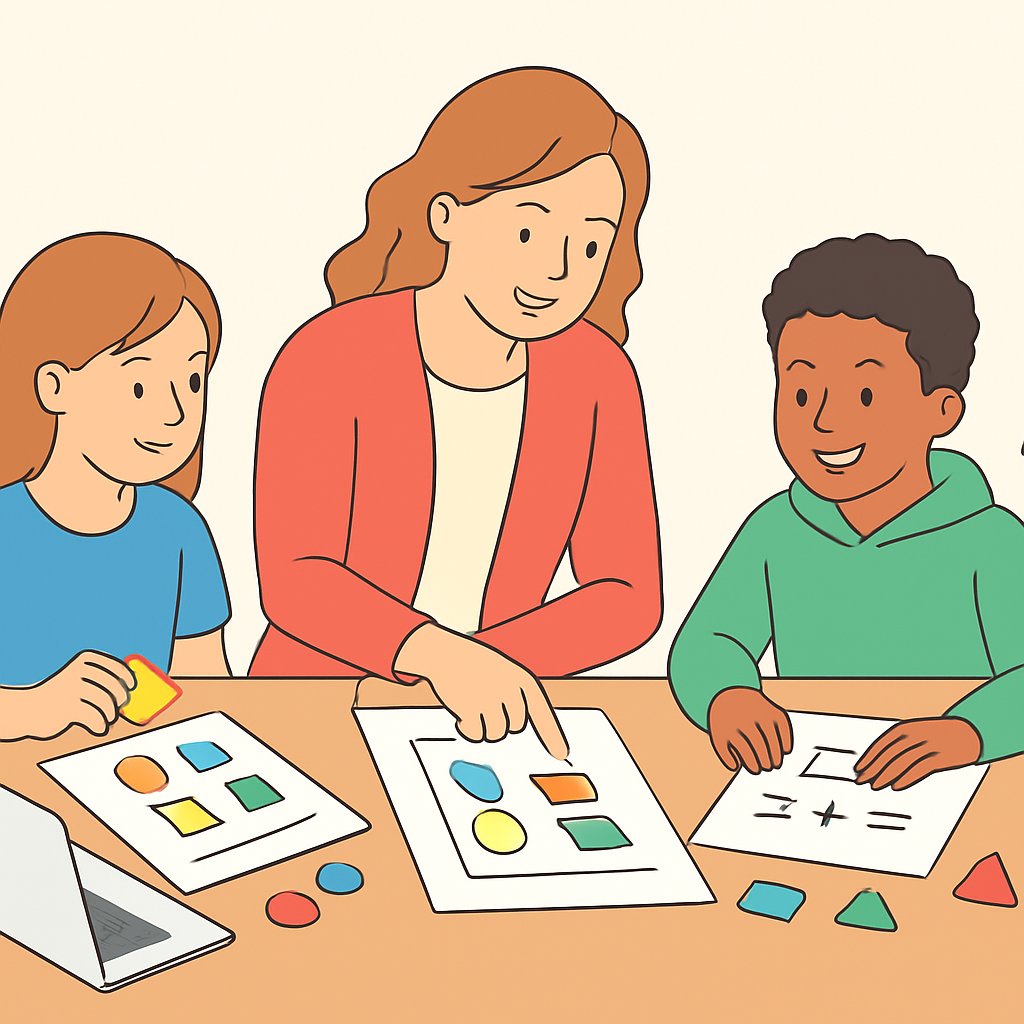
Structure Collaborative Projects That Require Communication, Roles, and Collective Reasoning
Define the project’s communication needs and collaborative goals.
Assign roles and scaffold collective reasoning across team members.
Evaluate both the process and the final product during milestones.
Designing Roles and Responsibilities
Begin by defining clear roles for each participant.
Next, describe responsibilities and decision authority for each role.
Additionally, rotate roles over time to build varied skills.
Moreover, align roles with group goals and project scope.
Establishing Communication Norms
Set expectations for how and when teams communicate.
For example, require brief check-ins at regular intervals.
Also, encourage active listening and asking clarifying questions.
Master Calculations Instantly
Unlock solutions for math, physics, engineering, and chemistry problem with step-by-step clarity. No internet required. Just knowledge at your fingertips, anytime, anywhere.
Furthermore, define a shared way to record group decisions.
Scaffolding Collective Reasoning
Provide prompts that require groups to explain their reasoning steps.
Then, encourage members to test and critique each proposed approach.
Additionally, supply visual space for teams to map ideas.
Moreover, ask teams to synthesize findings into a short summary.
Assessing Group Process and Products
Evaluate the collaborative process separately from the final solution.
Also, use rubrics that include communication and justification criteria.
Furthermore, incorporate peer feedback cycles during project milestones.
Finally, request short individual reflections on each member’s learning contributions.
Project Workflow and Milestones
Outline clear phases to structure progress and focus.
- Launch phase clarifies goals and assigns initial roles.
- Planning phase allows teams to choose strategies and resources.
- Working phase focuses on collective reasoning and solution development.
- Sharing phase has teams present methods and results to peers.
- Reflection phase encourages assessment of both process and learning.
Managing Challenges and Conflict
Anticipate disagreements about methods or interpretations.
Next, teach simple steps to resolve disputes within teams.
Also, allow brief pauses to revisit unclear assumptions.
Moreover, reassign tasks if a role does not fit a member.
Supporting Diverse Contributions
Design roles that value different strengths and perspectives.
Furthermore, invite quieter members to contribute through specific prompts.
Additionally, offer alternative means of participation beyond verbal discussion.
Practical Tips for Facilitators
Model concise explanations and transparent decision making.
Then, monitor group dynamics and intervene with targeted prompts.
Finally, celebrate effective collaboration and clear reasoning publicly.
See Related Content: How Matrices Are Used in Computer Graphics
Tiered Scaffolding for Self-Selected Challenge Levels
This guide describes tiered scaffolding for student choice.
Teachers provide clear pathways for learners to select challenge.
Students gain agency while teachers manage responsive support.
Designing Clear Tiers
Define a small set of tiers that differ by complexity and support.
Use descriptive labels that clarify expectations instead of numeric scores.
Specify the skill focus and the hint level for each tier.
Also define a clear success product or evidence of understanding.
- Specify the scaffolds or prompts available to students.
- State the expected product or demonstration of learning for that tier.
- Indicate suggested time or pacing for task completion.
- Include a short self-check checklist that students use to choose.
Guiding Student Choice
Offer brief, neutral prompts to help students assess readiness.
Then present sample indicators of progress tied to each tier.
Master Calculations Instantly
Unlock solutions for math, physics, engineering, and chemistry problem with step-by-step clarity. No internet required. Just knowledge at your fingertips, anytime, anywhere.
Also teach students how to reflect on fit and challenge.
Allow voluntary tier changes after quick formative checks.
Optional Extensions Menu
Create an extensions menu students scan after completing core tasks.
Furthermore, describe each option with a single sentence and a goal.
Also label extensions by type rather than by difficulty words.
- Deepen reasoning through added constraints or proof prompts.
- Broaden application by changing contexts or representation modes.
- Generalize results to wider classes or parameters.
- Create a concise challenge for peers to solve or improve.
Monitoring and Adjusting Support
Check student choices to detect mismatches between challenge and readiness.
Use quick tasks to gather evidence about student proficiency.
Then fade or add scaffolds based on observed need.
Record patterns of tier uptake to inform future lesson plans.
Sample Templates and Teacher Prompts
Provide concise templates teachers can adapt quickly during planning.
First template headings include tier description, support options, and check questions.
Next offer teacher prompts that guide student reflection and tier selection.
- What evidence shows you are ready for this tier?
- Which support will help you meet this tier’s expectation?
- If stuck, what small step can move you forward?
- After finishing, what extension will deepen your thinking?
When implemented, tiered scaffolds let students self-select appropriate challenge levels.
Additionally, teachers gain clearer pathways for responsive support.
Formative Checks and Reflective Prompts
This guide presents quick checks and reflective prompts for classroom practice.
Teachers can use these tools to gather timely evidence of learning.
Use results to inform immediate instructional choices and reteaching.
Purpose and Principles
Formative checks reveal learning gaps quickly.
They also guide immediate instructional choices.
Reflective prompts build learners’ metacognitive awareness.
Prompts encourage students to state strategies and confidence levels.
Designing Quick Formative Checks
Keep checks short and targeted to one idea.
Vary formats to maintain learner engagement.
Use prompts that require brief written responses.
- Ask for a single sentence justification of an answer.
- Use a one-line correction of a common mistake.
- Request a quick confidence rating and reason.
- Prompt learners to show the crucial step only.
Crafting Reflective Prompts
Frame prompts to focus on process choices.
Then ask students which step felt most difficult.
Also ask what strategy they would try next time.
Additionally invite learners to note one transferable insight.
Collecting and Using Evidence
Collect responses in brief and consistent formats for easy review.
Scan responses to find common misconceptions quickly.
Master Calculations Instantly
Unlock solutions for math, physics, engineering, and chemistry problem with step-by-step clarity. No internet required. Just knowledge at your fingertips, anytime, anywhere.
Adjust upcoming tasks based on the gathered evidence.
Share aggregate trends with students to guide reflection.
Integrating Checks into Practice
Embed checks at predictable pauses during practice sessions.
Set short windows for students to respond.
Schedule quick teacher check-ins to interpret evidence together.
Use responses to plan focused reteaching or enrichment moments.
Prompt and Check Templates
Provide templates that guide concise student responses.
Use prompts that ask for explanation or the crucial step.
Request confidence ratings and note errors avoided or corrected.
- Write one sentence explaining your answer choice.
- Circle the step that determined your result.
- Rate your confidence and explain that rating.
- Note one error you avoided or corrected today.
- State one next step to strengthen your understanding.
Teacher Reflection Routines
After practice, review a sample of student reflections quickly.
Identify two instructional moves to address common issues.
Record one change for the next practice cycle.
Revisit prompts to keep them concise and targeted.
Additional Resources
Google search results for How to Turn Routine Math Problems Into Meaningful Challenges Mathematics
Bing search results for How to Turn Routine Math Problems Into Meaningful Challenges Mathematics


