


Educational Rationale and Desired Learning Outcomes
Using tangible structures grounds abstract mathematical ideas in visible examples.
Tangible tasks increase student engagement through active participation.
Such work supports development of spatial and geometric intuition.
Benefits of Teaching Engineering Math with Tangible Structures
Hands on exploration encourages iterative problem solving and refinement.
Consequently, learners more readily connect calculation with observable behavior.
- This clarifies how theoretical formulas map to real structural behavior.
- It improves students’ ability to estimate and reason about measurements.
- Such thinking fosters practical approaches that complement formal mathematical study.
Desired Learning Outcomes
Educators should state clear, observable outcomes for instruction with structures.
These outcomes should be specific and measurable for assessment.
Teachers and assessors should align activities to stated outcomes.
Conceptual Understanding
- Students explain core mathematical principles behind simple structures.
- Learners relate geometric form to stability and load distribution.
- They describe assumptions embedded in common mathematical models.
Applied Skills
- Students translate physical observations into mathematical models and relations.
- They perform calculations to predict basic structural responses.
- Learners iterate models based on comparison with real outcomes.
Collaborative and Communication Skills
- Students present mathematical reasoning clearly to peers and instructors.
- They document assumptions and steps for reproducibility and review.
- Learners work together to test ideas and reconcile differing approaches.
Metacognitive and Transfer Skills
- Students reflect on when models succeed and when they fail.
- Learners adapt mathematical strategies to novel structural contexts.
- They evaluate model limitations and propose reasoned improvements.
Therefore, assessment should measure both conceptual understanding and practical application.
Curriculum Mapping for Structural Math
This document maps math topics to observable structural problems.
It prioritizes concepts that enable problem solving in real projects.
The sequence builds skills from measurement through analysis.
Mapping Principles
Map math topics directly to observable structural problems.
Next, prioritize concepts that enable problem solving in real projects.
Moreover, sequence skills so students build from measurement to analysis.
Also, align assessment to applied tasks rather than isolated drills.
Core Math Concepts and Matching Structural Problems
This section matches core math concepts to structural problems.
It links topics to tangible tasks used in projects.
These mappings inform task design and assessment choices.
Geometry and Spatial Reasoning
Geometry helps students describe shapes and spatial relationships.
It supports determination of dimensions and spatial layout for structures.
These skills enable accurate layout and alignment on site.
- Address planar layout and component fit problems.
- Estimate cross sectional shape and area for components.
- Resolve geometric constraints for form and alignment challenges.
Algebra and Linear Systems
Algebra allows students to relate variables and constraints in models.
It supports solving for unknowns in simplified structural representations.
Students use algebra to balance relationships within static models.
- Balance variable relationships in static models.
- Solve linear equations that represent system constraints.
Trigonometry and Angle Analysis
Trigonometry enables analysis of angles and proportional relationships.
It helps resolve component relations and geometric projections.
These tools assist with layout and connection geometry.
- Resolve angles for inclined members and connections.
- Use proportional relationships in triangular layouts.
Calculus and Continuous Change
Calculus supports modeling of continuous distributions and change.
It assists in understanding variable intensity across elements.
Master Calculations Instantly
Unlock solutions for math, physics, engineering, and chemistry problem with step-by-step clarity. No internet required. Just knowledge at your fingertips, anytime, anywhere.
Students reason about rates and accumulation in distributed effects.
- Use rate and accumulation reasoning for distributed effects.
- Model smooth variation along lengths or surfaces.
Statistics and Uncertainty Quantification
Statistics help quantify variability in materials and loading conditions.
They support risk aware decisions within design contexts.
Students describe variation and compare outcomes to expectations.
- Describe variation and confidence in measurement data.
- Compare observed outcomes to expected ranges.
Linear Algebra and System Modeling
Linear algebra supports coupled variables and multiple degrees of freedom.
It enables compact representation of interdependent elements.
This math helps model networked component interactions.
- Formulate matrix models for multi element interactions.
- Solve systems that represent networked components.
Progressive Skill Sequencing
Sequence skills so learners progress from concrete measurement to analysis.
Begin with basic practices and then increase modeling complexity.
This progression supports deeper analytical and design abilities.
Foundational Skills
Begin with accurate measurement and consistent unit practice.
Then develop basic geometric reasoning and algebraic manipulation skills.
Students practice scaled drawing and simple dimensional checks early.
- Practice scaled drawing and simple dimensional checks.
- Work simple equations that represent component relationships.
Modeling and Representation Skills
Next, teach abstraction from physical parts to mathematical models.
Then practice forming equations that represent those simplified systems.
Learners translate assemblies into compact model descriptions.
- Create basic free body descriptions for small assemblies.
- Translate geometric layouts into algebraic expressions.
Analytical and Computational Skills
Then, introduce solution strategies for coupled and continuous models.
Next, practice numerical methods and matrix problem solving where needed.
Teach techniques for solving multiple unknown problems efficiently.
- Solve systems with multiple unknowns using algebraic techniques.
- Analyze variation and trends using basic calculus where applicable.
Synthesis and Design Integration
Finally, integrate individual skills into iterative design activities.
Also, require justification of modeling choices and interpretation of results.
Students iterate designs based on modeled outcomes and constraints.
- Iterate design choices based on modeled outcomes and constraints.
- Refine models after comparing predictions to observed behavior.
Designing Learning Tasks and Assessments
Create tasks that target single mapped concepts for early practice.
Moreover, include integrative projects that require a sequence of skills.
Also, use checkpoints that assess modeling, calculation, and interpretation.
- Mini problems focused on a single concept for quick feedback.
- Modeling reports that document assumptions and solution steps.
- Peer review sessions that emphasize reasoning and clarity.
Scaffolding and Progress Monitoring
Provide concrete prompts that guide students through each modeling step.
Then, increase open endedness as competency and confidence grow.
Track progress with aligned rubrics for each mapped skill.
Criteria for Choosing Real Structures
This section lists criteria for choosing real structures.
Teachers can use these guidelines for lesson planning.
Master Calculations Instantly
Unlock solutions for math, physics, engineering, and chemistry problem with step-by-step clarity. No internet required. Just knowledge at your fingertips, anytime, anywhere.
The list emphasizes accessibility, complexity, and safety.
Accessibility Considerations
Focus on structures that students can access physically or visually.
Additionally, consider availability of materials and tools.
Also, assess whether learners need mobility or sensory accommodations.
Furthermore, include culturally familiar structures to increase engagement.
Managing Complexity
Choose examples that allow gradual increases in mathematical complexity.
Moreover, break complex designs into smaller teachable subproblems.
Also, ensure tasks align with clear measurable learning goals.
Additionally, plan optional extensions for advanced learners and enrichment.
Prioritizing Safety
Evaluate physical risks before selecting a structure for classroom work.
Furthermore, identify supervision levels and required protective measures.
Also, prefer low risk materials to reduce potential harm.
Moreover, document simple emergency and reporting procedures.
Practical Selection Checklist
Use the following checklist when choosing structures for math lessons.
Verify that accessibility matches learner needs and context.
Confirm that materials and tools remain available and affordable.
- Accessibility matches learner needs and context.
- Materials and tools remain available and affordable for the class.
- Mathematical concepts connect with observable structural features.
- Risk level stays within teacher and school safety policies.
- Complexity allows stepwise progression and optional extensions.
- Examples allow adaptations for different learner abilities and styles.
- Selection supports simple formative assessment strategies during lessons.
Implementation Notes
Pilot choices with small groups before full class implementation.
Furthermore, gather learner feedback to refine example suitability.
Also, prepare simple guides for setup measurement and troubleshooting.
Additionally, plan time buffers for unexpected challenges during activities.
Assessment and Scalability
Design assessments that measure reasoning and practical application.
Moreover, scale tasks to larger projects as skills and confidence grow.
Also, document adaptations to support future implementations across classes.
Delve into the Subject: Creative Ways to Teach Accuracy in Engineering Calculations
Fieldwork and Data Collection
This section covers practices for planning and conducting fieldwork.
Next, it explains measurement techniques, instrumentation, and data management.
Finally, it advises on quality assurance and classroom integration.
Preparing for Fieldwork
Define clear learning goals for the field visit beforehand.
Next, identify the types of measurements you plan to collect.
Then, arrange permissions and access with site hosts as needed.
Master Calculations Instantly
Unlock solutions for math, physics, engineering, and chemistry problem with step-by-step clarity. No internet required. Just knowledge at your fingertips, anytime, anywhere.
Also, plan basic safety and communication procedures for participants.
Finally, prepare a simple checklist for equipment and documentation needs.
Guided Measurement Techniques
Begin with demonstration of proper measurement posture and handling.
Next, show how to align measurement references with structural elements.
Then, guide learners through repeated measurements for consistency.
In addition, teach note taking that records context and observable conditions.
Furthermore, encourage learners to verbalize assumptions during measurement.
Dimensional and Geometric Observations
Measure linear and angular dimensions methodically and consistently.
Then, sketch simple diagrams to link measurements to geometry.
Also, record units and reference points for every dimension collected.
Qualitative and Behavioral Observations
Observe visible deformations and material conditions alongside numeric readings.
Next, describe environmental conditions that might affect measurements.
Then, note any unusual features that warrant follow up measurements.
Instrumentation and Sensors
Choose instruments that match the measurement goals and expected ranges.
Then, check instrument readiness and battery or power status before use.
Next, perform a quick calibration or zeroing step where possible.
Also, keep instrument handling consistent across different users and sessions.
Finally, document instrument settings and sampling intervals with the data.
Recording and Organizing Empirical Data
Label every dataset with clear identifiers and brief contextual notes.
Next, use consistent file naming and folder structures for easy retrieval.
Then, capture metadata about date, time, and environmental conditions.
Also, separate raw data from processed or interpreted datasets for clarity.
Furthermore, create routine backups to prevent accidental data loss.
- Use standardized templates for datasheets to reduce recording errors.
- Also, include fields for observer name and measurement uncertainty estimates.
- Finally, maintain a log of data processing steps for reproducibility.
Quality Assurance and Data Validation
Implement repeat measurements to assess consistency and variability.
Next, compare independent observers to identify systematic differences.
Then, flag outliers and record reasons for their inclusion or exclusion.
Also, document known sources of uncertainty alongside the measurements.
Furthermore, review datasets promptly to catch recording mistakes early.
Integrating Field Data into Classroom Activities
If you already aligned concepts to problems, integrate collected data next.
Then, curate subsets of data for targeted exercises and exploration.
Master Calculations Instantly
Unlock solutions for math, physics, engineering, and chemistry problem with step-by-step clarity. No internet required. Just knowledge at your fingertips, anytime, anywhere.
Also, design tasks that require students to clean and visualize empirical data.
Furthermore, prompt reflection on how field conditions influenced measurements.
Finally, archive annotated datasets for future reuse and iterative learning.
Uncover the Details: Why Electrical Engineering Relies Heavily on Math
Mathematical Modeling Workflows
Modeling begins by identifying measurable quantities from the structure.
Identify physical principles that constrain the structure’s behavior.
Compare model predictions against observed behavior or measurements.
From Observations to Variables
First, select variables that capture essential behavior.
Next, define symbols and units clearly.
Additionally, relate measurements to variables with simple expressions.
Formulating Governing Equations
Then write balance laws, compatibility, or constitutive relationships as equations.
Use dimensional consistency to check each equation.
Moreover, express boundary and loading conditions explicitly.
Assumptions and Justifications
State each assumption clearly and justify its inclusion.
Prefer assumptions that make models tractable yet relevant.
Also note when assumptions limit a model’s applicability.
Simplification Strategies
- Simplify geometry using symmetry or idealized shapes.
- Reduce degrees of freedom through lumped parameters when appropriate.
- Linearize nonlinear behavior near operating points when valid.
- Retain dominant effects and discard negligible influences.
Choosing Solution Techniques
Match analytical methods to simplified model forms when possible.
Otherwise, select numerical approaches that suit problem scale.
For classroom settings, prefer methods that illuminate underlying concepts.
Also consider computational cost and available student time.
Validation and Iteration
Then revise assumptions and equations when discrepancies arise.
Iterate until the model achieves acceptable fidelity for the task.
Document the model’s limitations and remaining uncertainties.
Teaching Workflow as a Skill
Break the modeling process into explicit, teachable steps.
Use scaffolded exercises that build from simple to complex tasks.
Encourage students to justify each modeling choice verbally or in writing.
Finally, debrief on how assumptions affected results and learning.
Uncover the Details: How Calculations Are Powering the Renewable Energy Revolution
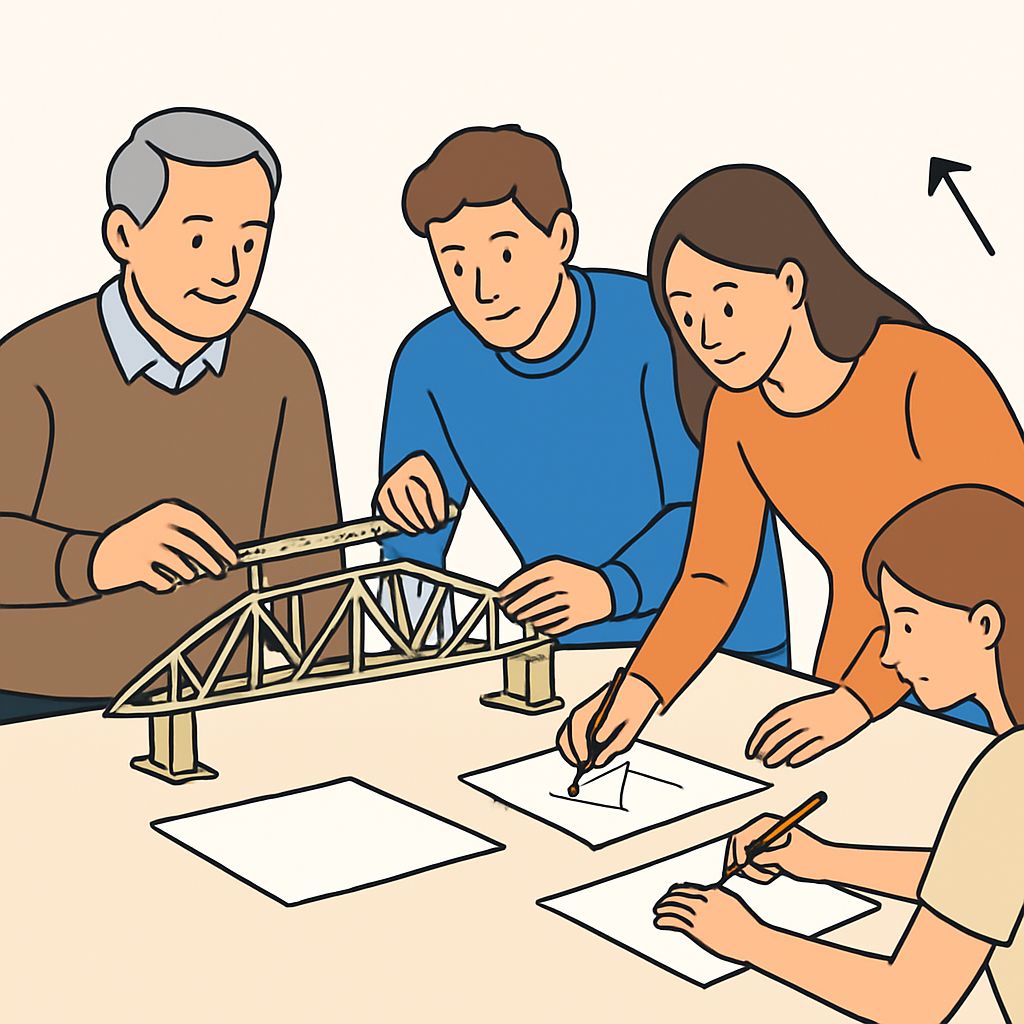
Hands-on Learning Activities
Hands-on activities let students connect math to tangible forms.
They emphasize proportion, ratio, and geometric similarity.
Master Calculations Instantly
Unlock solutions for math, physics, engineering, and chemistry problem with step-by-step clarity. No internet required. Just knowledge at your fingertips, anytime, anywhere.
Plan clear scaling factors and dimensional guidelines before construction.
Scaled Builds
Scaled builds let students connect math to tangible forms.
In addition, they emphasize proportion, ratio, and geometric similarity.
Furthermore, encourage students to document measurements and calculations as they build.
- Choose units that simplify proportional calculations.
- Set tolerances to teach error analysis and precision.
- Use repeated elements to illustrate scaling laws.
Experiments with Structural Concepts
Experiments allow students to test mathematical predictions.
They reinforce hypothesis formulation and quantitative measurement skills.
Design experiments that isolate a single variable where possible.
Have students predict outcomes using simple calculations before testing.
- Measure deflection under controlled loading to relate force and displacement.
- Compare geometric arrangements to assess stability and equilibrium qualitatively.
- Track changes after incremental adjustments to explore rate and slope concepts.
Classroom Projects and Workshops
Classroom projects let teams apply math to meaningful tasks.
Workshops build iterative design and peer feedback practices.
Organize projects around clear deliverables and assessment criteria.
- Small group builds that require budgeting and material estimation.
- Design challenges that focus on optimizing a specific performance metric.
- Reflection presentations that link calculations to observed performance.
Assessment and Reflection Strategies
Assess hands-on work with rubrics that highlight mathematical reasoning.
Collect student logs that document calculations and design choices.
Use short quizzes to confirm procedural fluency after activities.
Encourage peer critique sessions to deepen analytical communication skills.
Practical Tips for Implementation
Plan time buffers for construction, testing, and revision phases.
Prepare flexible rubrics to accommodate varied design solutions.
Include basic safety briefings before hands-on sessions.
Document outcomes to build a reference for future activities.
You Might Also Like: How Structural Calculations Prevent Catastrophic Failures
Visualization and Computational Support
Use visuals to link equations to observable structural behavior.
Visualizations reveal how parameters affect deformation and internal forces.
Combine computation and sketches to improve mathematical modeling workflows.
Purpose of Visual and Computational Methods
Visual and computational methods connect equations to structural behavior that learners can observe.
For example, they show how parameter changes alter deformation and load distribution.
This practice reinforces links between algebraic terms and visual responses.
Sketches and Diagram Practices
Start with clear hand sketches that simplify complex geometry into basic elements.
Next, annotate sketches with forces, supports, and coordinate directions.
Additionally, layer equations and assumptions directly onto diagrams for clarity.
Also use scaled sketches to show relative magnitudes and proportions.
Master Calculations Instantly
Unlock solutions for math, physics, engineering, and chemistry problem with step-by-step clarity. No internet required. Just knowledge at your fingertips, anytime, anywhere.
- Use sequential sketches to show steps in a derivation or transformation.
- Overlay sketches to compare idealized models with observed shapes.
Simulations and Interactive Models
Begin with simple simulations that illustrate single phenomena clearly.
Then enable parameter adjustments to reveal sensitivity and trends.
Consequently, students observe direct links between algebraic terms and visual responses.
Furthermore, use animations to show loads, vibrations, and progressive deformation.
- Provide guided scenarios for students to explore cause and effect.
- Include checkpoints that ask learners to predict outcomes before viewing results.
Software Interfaces and Visual Outputs
Present numerical results alongside visual outputs for immediate comparison.
For example, show plots of response versus time next to deformed shapes.
Additionally, display contour-style visuals to communicate gradients and stress distributions.
Moreover, use simplified output views to avoid overwhelming beginners.
- Offer exportable data so students can analyze results with familiar tools.
- Provide adjustable visualization settings to match student experience levels.
Integrating Visuals into Instruction
Sequence activities from sketches to simulations to build conceptual links progressively.
Next, pose prediction tasks before running computational demonstrations.
Then, encourage reflection on differences between models and observations.
Additionally, scaffold tasks with increasing model complexity for skill development.
- Run short in-class labs that alternate analytic work with visual checks.
- Use group work to have students explain visual outputs in mathematical terms.
Assessment and Feedback Using Visual Tools
Design assessments that require explanation of visual results in equation terms.
Also use visual artifacts as prompts for formative feedback cycles.
Provide rubrics that value correct interpretation and clear visual communication.
Assessment and Extension Strategies
This section outlines assessment approaches.
It also outlines pathways to professional practice.
Additionally, it presents structures for extending learning beyond classroom boundaries.
Formative Assessment Practices
Teachers use short, frequent checks to monitor student understanding.
Moreover, they design tasks that reveal procedural and conceptual gaps.
Furthermore, peer review sessions encourage critique and collaborative improvement.
Also, quick sketches or verbal explanations help surface reasoning during activities.
Summative Assessment Designs
Summative tasks evaluate integrated understanding at defined course milestones.
Assessments combine written analysis with tangible deliverables when appropriate.
Oral presentations demonstrate communication of mathematical reasoning for structures.
Comprehensive reports synthesize modeling, results, and interpretation into coherent narratives.
Capstone Project Frameworks
Capstone projects provide culminative experiences that integrate course learning.
First, students develop proposals that state objectives and intended outcomes.
Next, teams create plans for analysis, experimentation, and evaluation.
Then, groups execute the plan and collect evidence to support conclusions.
Master Calculations Instantly
Unlock solutions for math, physics, engineering, and chemistry problem with step-by-step clarity. No internet required. Just knowledge at your fingertips, anytime, anywhere.
Finally, students present findings and reflect on technical and process learning.
- Project phases include proposal, design, implementation, testing, and reflection.
- Deliverables can include technical reports, models, or demonstration artifacts.
- Assessment emphasizes both product quality and documented decision-making.
Pathways to Real-World Engineering Practice
Programs can create bridges to practice through applied project work and mentorship.
Moreover, partnerships with practitioners provide context for professional expectations.
Also, supervised practica allow students to apply classroom skills in authentic settings.
Consequently, learners gain exposure to workflow norms and collaborative problem solving.
Furthermore, public exhibitions enable dialogue with stakeholders and potential collaborators.
Rubrics, Feedback, and Reflective Processes
Clear rubrics align assessment criteria with learning outcomes and practice standards.
Additionally, instructors provide timely, actionable feedback to guide revisions.
Students document iteration through brief reflective entries after major tasks.
Moreover, self-assessment prompts cultivate metacognition and ownership of learning.
Extension and Differentiation Options
Educators offer tiered challenges to accommodate varied proficiency and interest levels.
Also, optional independent studies let motivated students explore deeper questions.
Furthermore, modular extensions enable learners to specialize in particular structural topics.
Consequently, pathways support both remediation and advanced exploration within the same course.
Sustaining Professional Connections
Programs encourage ongoing contact between students and practitioners after course completion.
Moreover, alumni showcases help maintain networks and share evolving project work.
Additionally, curated portfolios document growth and support transition to professional roles.
Finally, structured reflection helps learners translate academic experiences into career narratives.
Additional Resources
Google search results for How to Introduce Engineering Math Through Real Structures Engineering
Bing search results for How to Introduce Engineering Math Through Real Structures Engineering


